In short… A destination restaurant, guesthouse and working farm in the village of Saint-Vrain, an hour outside of Paris. Guests can come for lunch or dinner and choose to spend the night in one of the 11 rooms, making the entire experience feel like you’re staying at the home of an aristocratic aunt.
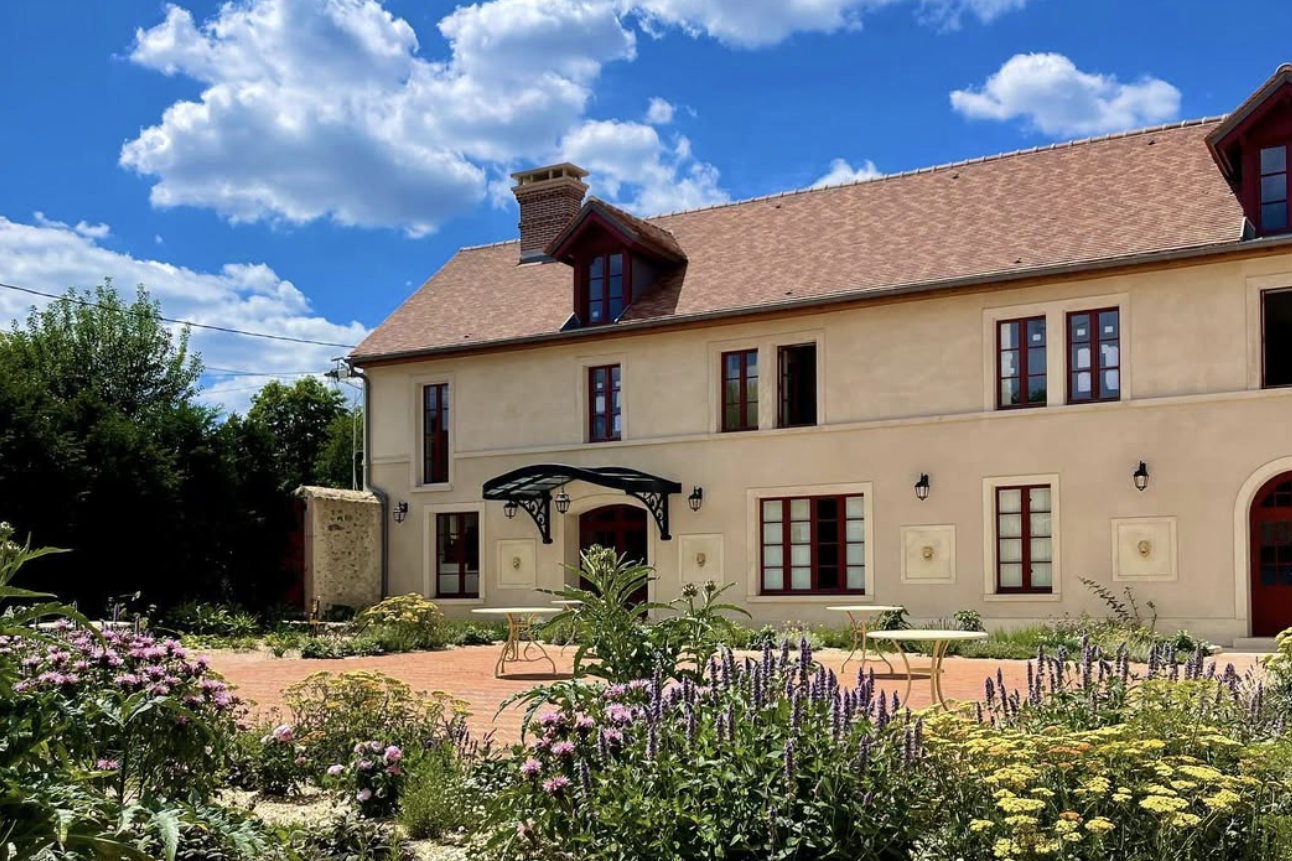
The backstory… Set in a refurbished stable on the grounds of Château de Saint Vrain—a large estate that once belonged to Louis XV’s mistress—Le Doyenné has a rich history. At the end of the French Revolution, the estate was bought by the Mortemart family, one of France’s oldest aristocratic lines, and for two centuries had been passed down through the generations—gently decaying along with the French nobility. More recently, in collaboration with Australian chefs James Henry and Shaun Kelly, they transformed the historic stables into Le Doyenné, which opened in 2017. The partnership involved recruiting various local craftsmen and artisans to restore and convert the building into the restaurant and guesthouse, preserving the integrity of its original structure.
The surroundings… There’s not much to see in the town of Saint-Vrain itself. In fact, the regional train drops you off a few towns away in Bouray. But it’s easy enough to get to if you plan ahead. Thursday through Saturday, there’s a local bus, or if you’re lucky, you can call an Uber, but I recommend phoning the inn ahead of time and asking them to arrange a taxi. I arrived on a Sunday and did not plan ahead, so I ended up hitching a ride from a local woman who found me stranded. Once you arrive, there’s plenty on the Château de Saint-Vrain’s 175-acre grounds to explore. You’re welcome to wander through the gardens and the open field off the back of the restaurant, or peer into the greenhouse. There are animals on the farm as well near their larger fruit and vegetable patch, which are tucked away toward the back of the property and off limits during your stay.

The vibe… The entrance of Le Doyenné is guarded by an old watch tower, a stone building overgrown with grass and moss. Through wooden gates and down the gravel driveway, past fields of wildflowers and a small outbuilding which doubles as the gift shop, is where you’ll find the main guesthouse. The woman who drove me dropped me off at the entrance to a quaint L-shaped building made from white stone and wood, where another woman waited to greet me. She led me down a wide hallway that brimmed with French charm in every detail—sun hats hung from antique wooden hooks and dried flowers displayed in glass, as if someone’s just gone out for a bit and forgotten to water the peonies. It smelled of old oak and roses.
Down the terracotta tiled hall and past the spiral staircase that leads up to the rooms, I was led into the main dining room. If the outside of the inn is fairly unassuming, the dining room reveals a grandeur that reminds you this building was once attached to a castle. The room is massive, with tall ceilings and glass walls. From the dining room, you can see the potager, or vegetable garden, which, in late June, was ripe with perennial vegetables, herbs and flowers. The garden sits on the site of the estate’s original potager, which had lain dormant for over 60 years.
Before dinner starts it’s nearly empty, save for a few servers putting the final settings on tables. Arriving here feels almost like walking into the hollowed out center of an old redwood, the clamor of dishes coming from the open kitchen echoes in the open space. At one end of the dining room there is seating around a massive stone fireplace with a record player and vinyl collection that guests can rummage through as they wait for dinner to start.

Check-in took place at a large, stained oak table that doubles as a bar. My favorite detail was the duck decanters they had arranged on a silver tray next to a guestbook and a stack of menus, bound in leather. I was offered a drink, and accepted a carafe of water to take to my suite. The room was small but comfortable, with hues of green and white linens, the smell of fresh laundry and freshly cut grass. Most guests at Le Doyenné come for a meal at the restaurant—either lunch, which is served Friday through Sunday—or dinner, which is offered each week starting on Thursdays, but staying the night was such a treat, and remarkably affordable—for the 10 course dinner and a room, which includes complimentary breakfast, it cost just over $400.

The food & drink… Chefs James Henry and Shaun Kelly met while they both worked at Paris’ Au Passage, which rose to fame in the early 2010s for its upscale hyper-local, seasonal bistro-style cooking. At Le Doyenné, Henry and Kelly farm everything using regenerative agricultural practices. To say the menu changes seasonally is an understatement. It really changes daily, based on the produce they harvest from the garden each morning. The meal is 10 courses, pre-fixe, with an optional cheese course towards the end, which I highly recommend. Whatever the restaurant can’t source from the onsite farm, they get from regional producers–game, poultry, dairy and seafood.
Dinner began at 7, but I headed down early for a glass of wine and a bowl of olives to hold me over. Their wine selection was superb and honors the restaurant’s agricultural ethos, sourcing bottles exclusively from low-intervention, natural wine producers from across Europe. They offer a wine pairing with your meal for an additional 80 euro per person, but I opted for wine by the glass throughout the evening. My first glass was a sparkling pet-nat from Domaine Mosse, prolific natural wine producers from the Loire Valley. It’s the color of watermelon and tastes of red raspberry and pink peppercorn.
The other guests started drifting into the dining room around 6:30. Mostly they were couples, of all ages and from all over. Some were there to celebrate birthdays or anniversaries, others came on the recommendation of a friend. One architect-writer couple from Brooklyn I chatted with said they had Le Doyenné on their bucket list for a while, and we exchanged recommendations for restaurants in Paris and New York.
I was taken to my table, which was set with a vintage silver napkin holder imprinted with the word “madame”—such a charming detail! In the center of the room, an antique oak table was stacked high with loaves of fresh bread, wheels of cheese, and a bucket of ice filled with wine. Another one of these wooden benches is set up by the open kitchen, scattered with bowls of mushrooms and a mortar and pestle made for giants.
To start, we were served three plates, each with a single slice of hand-cured meats, an array of crudité, and a side of pain complet maison served with salted butter on a half shell. In late June, the mains consisted of an ajoblanco, a cold soup made from crushed almonds and seasoned with vinegar, and a filet of lamb cooked to perfection swimming in brown sauce. Desserts are most often a duo of house-churned ice cream and a seasonal tart. Coffee and tea are best enjoyed on the back patio, which overlooks the greenhouse.

In the morning, breakfast is served in a small room off of the main dining room, laid out on an antique dresser converted into a bar filled with homemade bread and butter, jam and pastries. I opted for the homemade granola with seasonal fruit compote made with strawberries from the farm and black coffee from a small roastery in Saint-Romain, Burgundy. Guests can also have made-to-order omelets and French toast, which looked delicious.

The rooms… The guesthouse has 11 rooms, with larger suites that sleep four people comfortably. As a solo traveler, I was given a small, cozy room at the top of the stairs, decorated with ornate wallpaper, terracotta tiles, brass and wooden finishes. Two warped windows opened to the front garden, an island of grass in the middle of the gravel driveway that was overgrown with flowers. The bathroom is broken up: a sink by the bed, a walk-in shower off of the main room, diagonal from the WC. The rooms are spacious yet cozy, filled with light and quiet enough to hear a pin drop. Probably one of the best nights of sleep I’ve ever had.
The wellness… While the hotel doesn’t have a dedicated spa, the entire visit feels like an overnight at a meditation retreat. There is minimal cell service and spotty wifi, which offers the perfect excuse to unplug. I recommend a long hot shower or bath in their earth-tone tiled shower—bathrooms are stocked with loofahs, bath salts, and lotions from sustainably made Swiss soap brand, Soeder.
The family-friendliness… Children are welcome, although they have minimal accommodation for kids, especially toddlers or babies–it’s more ideal for a romantic night away.

Be sure to… Stop into the gift shop on your way out, which swaps the usual mugs and keychains for locally crafted ceramic dishes, garden tools, and the same artisanally roasted coffee they serve at breakfast. Also call ahead and request a taxi from the train station in the neighboring town of Bouray, as local transportation is sparse.
Parting words… A once in a lifetime experience that I would love to repeat!
Date of stay… June 2024
Leave a Reply
You must be logged in to post a comment.